


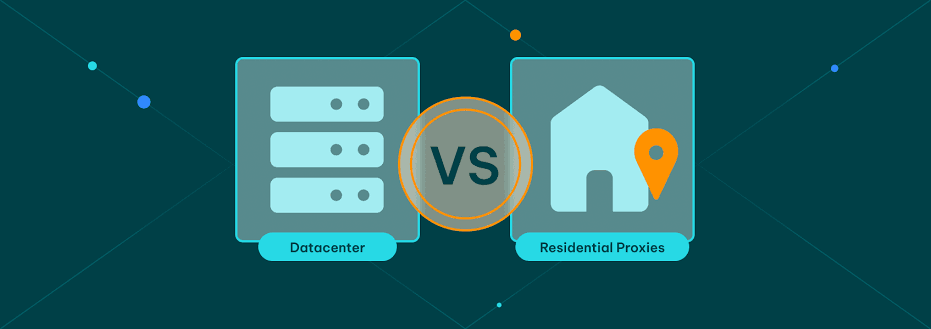

Among the online privacy and internet automation scenarios, proxies are widely used to connect to websites, collect data, and protect the anonymity of individuals or entities. Residential proxies and datacenter proxies are among the most common types. Although each provides a mask, the origin, legitimacy, reliability, and commonly used purposes of the target IP address are quite different for each. These are critical differences — and one should know whether a proxy will serve your needs properly.
Origin and IP Assignment
Relatively easy residential proxies are essentially IP addresses assigned by Internet Service Providers (ISPs) to real households. When a request is made through a residential proxy, a website sees the traffic as coming from an actual home user. Datacenter proxies, by contrast, are derived from datacenter sites — big institutions that host servers and IP addresses that are independent of an ISP. These IPs are not registered in a physical home and so will likely be more likely to show up as automation traffic on websites.
Legitimacy and Detection
One of the advantages of residential proxies is the high degree of legitimacy they achieve. Because it comes from legitimate home premises, real user traffic is treated as such—reducing the probability of blocking user files as well as blocking them with a suspicious message. Datacenter proxies are cheaper and faster-to-implement but are detected better by anti-bot systems. Datacenter IPs can also be blocked by sites if they see unusual patterns in traffic, which results in unreliable operation if an object or a session doesn’t match the user’s background, because services need consistent access to the site, or if they’re modelled to actual user behaviour.
Speed and Performance
Datacenter proxies generally offer better speeds and lower latency as they receive services over a server that is more efficient and has more reliable internet links. Residential proxies – although a few clicks slower, since the proxies are routed via the connections of real users – have more stability in terms of long term access and reliability. The balance between speed and authenticity is a central issue: datacenter proxies perform well for fast data collection, but their ability to break could vary due to blocks and residential for long time of operation operations where legitimacy and anonymity are paramount.
Cost Differences
Residential proxies generally cost more than datacenter proxies. The inflated price is due to the scarcity of IPs from actual households and the additional legitimacy they provide. Datacenter proxies are cheaper and more widely used than residential proxies, which makes them attractive for big operations where they do not need high levels of legitimacy or geo-target the user. Like automated testing, speed scraping tools, bots operating on less secure sites, etc.
Use Cases
Residential proxies are well-suited to legitimate tasks such as web scraping on e-commerce websites, ad verification campaigns, multilevel accounts on many social media sites or accessing geo-restricted content. They can rotate IPs and look like actual users, making them ideally suited for sensitive tasks that require someone else to be able to hide behind a screen. Datacenter proxies are appropriate for use cases in which speed exceeds authenticity, e.g. when they need to extract data without a need for accuracy or have to do an automated data extraction, load testing or crawling up from non-restricted websites or for even very simple web-crawling tasks with an unlikely block of data.

Anonymity and Security
But where both provide anonymity, residential proxies are a little less opaque, as the traffic is viewed as traffic that is normal user activity with a more secure identity for the user. This does lessen the chances of IP banning and enhances privacy. Datacenter proxies protect identity, but can be more prone to being flagged as suspicious when an attacker tries to perform the same/high volume / repetitive tasks – more likely to be suspicious.
Geo-Targeting Capabilities
Also, the residential proxies are found in specific countries, cities, and even neighborhoods making them very effective for tasks that require location-specific IP addresses. Datacenter proxies offer more locations per address but are not able to reproduce the granular, representative IP data that residential proxies allow. Residential proxies, for price tracking, localisation of SEO testing, and regional content access, are generally superior.
It all comes down to deciding between residential and datacenter proxies since whatever task you are doing may demand you to use another. Residential proxies are authentic, reliable, have a higher level of resistance to detection and fit in well with sensitive, long-term and site-specific activities. Datacenter proxies are fast, inexpensive and very easy to scale, which is great for high-volume processes in which detection risk is low when deployed on large datasets. With a clear understanding of the advantages and disadvantages of each, entities can plan and ensure that they use a proxy that is good for their online goals.